eCheck processing lets your customers pay straight from their checking account, online, over the phone, or on a recurring schedule. It costs less than card processing, handles larger tickets, and gives your business a second payment rail when card processors get nervous.
The catch most merchants learn the hard way: plenty of eCheck providers turn down the same high-risk industries card processors do. The Merchant Guru works with eCheck partners that underwrite high-risk businesses, and we can set up eCheck alongside your card processing or on its own.
No hidden fees. No long-term contracts. Just a straight read on whether eCheck fits your business.
By submitting this form, you are acknowledging and consenting to our terms.
We do not distribute your information
eCheck runs on the ACH Network, not Visa or Mastercard, so it can keep revenue coming in while your card account gets sorted out. Call us and we’ll tell you honestly whether it fits.
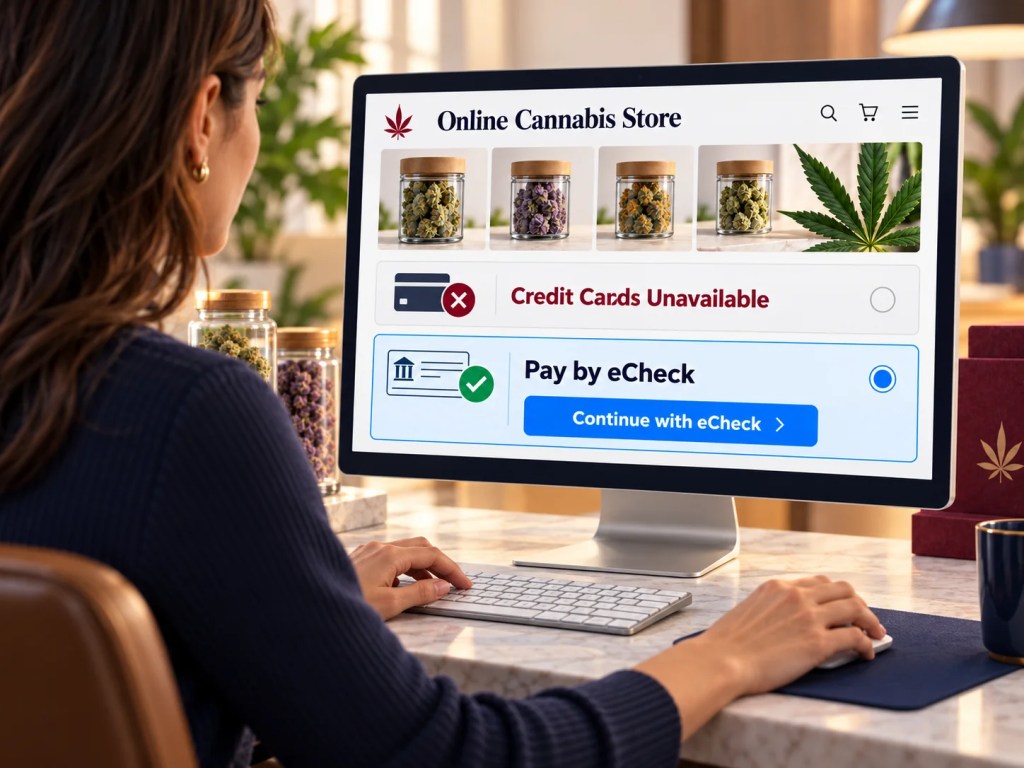
An eCheck is an electronic debit from your customer’s checking account. Instead of writing a paper check, the customer enters their routing and account number, authorizes the payment, and the funds move through the ACH Network under the Nacha Operating Rules.
STEP 1
Authorize
Customer enters bank details and agrees to the debit online, by phone, or on paper.
STEP 2
Verify
The account is validated before the first debit, as Nacha requires for web payments.
STEP 3
Originate
Your processor sends the entry to its bank (the ODFI) in an ACH batch.
STEP 4
Settle
Funds typically settle in one to three business days, then deposit to your account.
eCheck vs. ACH in one sentence: ACH is the network, and an eCheck is one way of using it to pull a payment from a customer’s checking account. We cover the details in our guide to eCheck and ACH processing for high-risk merchants.
Cards will always be the main way most customers pay. eCheck doesn’t replace them, but it solves problems cards can’t:
Real talk: eCheck has its own rules. Consumers can return an unauthorized debit for up to 60 days, and Nacha watches your return rates the way card brands watch chargebacks. Set up correctly, it’s one of the most stable payment options a high-risk merchant can have.
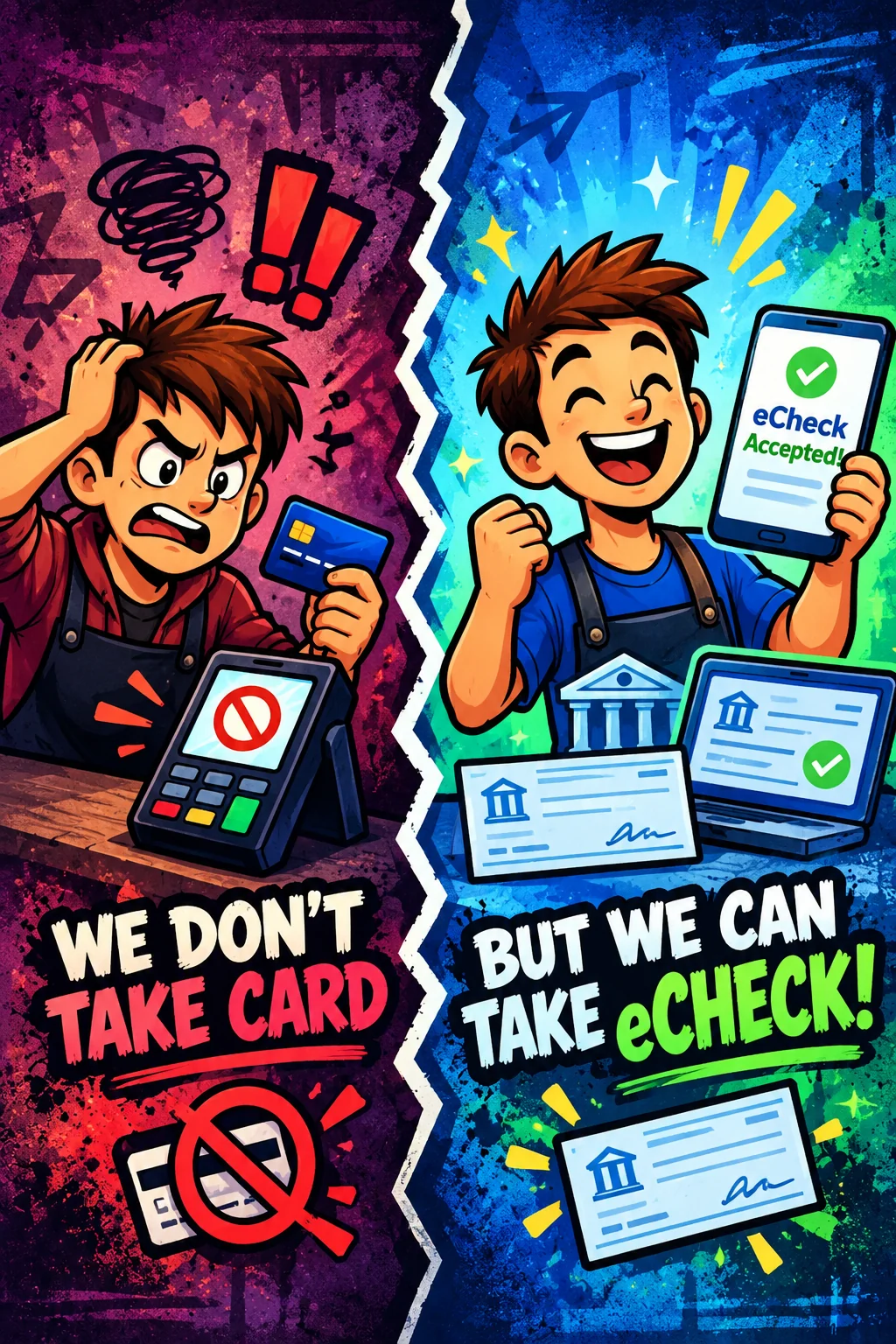
Here’s how the two compare on the things that matter to a high-risk merchant. Neither is better across the board, which is why many of our merchants run both.
| eCheck (ACH) | Credit Card | |
|---|---|---|
| Network & rules | ACH Network, governed by the Nacha Operating Rules | Visa, Mastercard, Amex, and Discover rules |
| Cost structure | Usually a flat per-item fee or a low percentage, no interchange | Interchange + card brand fees + processor markup |
| Ticket size | Limited by your approved limits and the customer’s balance | Limited by the customer’s credit limit and card fraud rules |
| Speed to funds | Typically one to three business days | Typically one to two business days |
| Customer disputes | Returns: two banking days for insufficient funds, up to 60 days for unauthorized consumer debits | Chargebacks: generally up to 120 days for most Visa disputes |
| Monitoring programs | Nacha return-rate thresholds (0.5% unauthorized, 3% administrative, 15% overall) | Visa VAMP and Mastercard chargeback monitoring programs |
| Recurring billing | Account numbers rarely change | Cards expire, get reissued, and decline |
| Funds check at checkout | No real-time authorization unless you add verification | Real-time authorization against available credit |
Exact timing, fees, and limits depend on your provider and underwriting.
These are the situations we see most. Each one maps to a Nacha entry type, called an SEC code, that sets the authorization rules you’ll follow.
Travel packages, vacation clubs, equipment, tuition, and other sales where card limits and fees get painful.
WEBPPD
Monthly billing that doesn’t break when a customer’s card expires or gets reissued.
WEBPPD
Installment billing for services paid over several months.
WEBPPD
Business customers paying invoices from a company checking account.
CCD
Payments taken by phone, with recorded oral authorization or a written notice sent before the debit.
TEL
Buyers who don’t have a credit card, have maxed one out, or simply prefer paying from their bank.
WEB
A second rail when card volume is capped, a reserve is holding funds, or a card account is under review.
WEBTELPPD
Converting checks received in person or by mail into electronic debits, so there are no trips to the bank.
BOCPOPARC
SEC code cheat sheet: WEB is internet-authorized consumer debits. TEL is phone-authorized. PPD is written consumer authorization. CCD is business to business. BOC, POP, and ARC convert paper checks. Using the wrong code is one of the quickest ways to trigger returns and bank scrutiny.
Every eCheck provider relies on a bank, called an ODFI, to send its payments into the ACH Network. That bank answers to Nacha for every return its merchants generate, so many keep long restricted-industry lists. Most eCheck providers simply mirror them, which is why supplements, travel, adult, firearms, CBD, and financial services merchants often hear no.
We support many industries that other eCheck providers won’t. We work with eCheck partners whose banks underwrite high-risk businesses, then build your file around what those underwriters need to see.
We won’t pretend every business qualifies. Some models are hard to place with any bank. If eCheck isn’t a realistic fit for you, we’ll say so, and focus on getting your card processing right instead.
There are too many industries to list on one page. We also work with debt settlement, bail bonds, timeshare, money services, prop firms, and more. Tell us what you sell and how you bill, and we’ll tell you straight whether eCheck, cards, or both make sense.
Card merchants watch Visa and Mastercard. eCheck merchants answer to Nacha, and the rules tightened again this year. Here’s what applies to you.
March 2021
Web debit account validation
Before debiting a bank account for the first time online, the account must be validated with a commercially reasonable fraud detection system.
March 2022
Same Day ACH limit rises to $1 million
Eligible payments up to $1 million per transaction can settle the same business day.
March 20, 2026
Fraud monitoring, phase one, and “PURCHASE” descriptors
Large originators and processors must run risk-based monitoring for unauthorized and false-pretenses payments. Ecommerce WEB debits must carry the description “PURCHASE.”
June 22, 2026
Fraud monitoring, phase two
The monitoring requirement extends to every remaining originator and Third-Party Sender, regardless of volume.
| Return Category | Threshold | Return Codes Included |
|---|---|---|
| Unauthorized | 0.5% | R05, R07, R10, R11, R29, R51 |
| Administrative | 3% | R02 (closed), R03 (no account), R04 (invalid number) |
| Overall | 15% | All debit returns, excluding RCK |
Why this matters: go over these thresholds and your bank has to step in, which can mean fines, a reserve, or losing eCheck entirely. We help you set up authorizations, validation, and descriptors correctly from day one. Confirm requirements that apply to your business with your provider or counsel.
Most eCheck accounts go from application to live in days, not weeks. Have these ready:
Things that help: clear authorization language, account validation, accurate billing descriptors, and easy cancellation.
Things that raise flags: high prior return rates, vague checkout terms, and recurring billing customers didn’t clearly agree to.
Ready to go? Start your eCheck application. It takes about five minutes, and there’s no obligation.
Getting an eCheck account is one thing. Keeping it open, with return rates under control, is where most providers leave you on your own.
Banks and processors that underwrite the industries other eCheck providers turn away.
Run both through one relationship, so a problem on one rail doesn’t stop your revenue.
We check your checkout language and SEC codes before you go live.
Per-item fees, percentages, and reserves explained before you sign.
When returns spike or a bank asks questions, you call someone who knows your file.
A lot of merchants come to me after their card processor capped them or froze their funds, and nobody ever told them eCheck was an option. For the right business, it’s cheaper, it handles big tickets, and it keeps money moving when cards get complicated.
It isn’t magic, though. Nacha watches returns closely, and a sloppy checkout page can cost you the account. My job is to match you with a bank that wants your business, and make sure your setup holds up after you’re approved.
If you want a straight read, even if the answer is “stick with cards,” give me a call.
Russell Silva, Founder, The Merchant Guru
eCheck processing lets a business debit a customer’s checking account electronically, with the customer’s authorization. The payment moves through the ACH Network under the Nacha Operating Rules, instead of through the card networks.
ACH is the network that moves money between U.S. bank accounts. An eCheck is one type of ACH payment: a debit pulled from a customer’s checking account after they authorize it online, by phone, or on paper. All eChecks are ACH payments, but ACH also covers direct deposit, bill pay, and business transfers.
Most eCheck payments settle in one to three business days. Some providers hold funds a few extra days to cover the return window, especially for newer or high-risk accounts.
Yes. An eCheck can come back as a return instead of a chargeback. Insufficient funds returns usually arrive within two banking days, and consumers can return a debit they say they didn’t authorize for up to 60 days. Returns count toward Nacha’s thresholds, so clear authorization matters.
Usually. eCheck has no card interchange or card brand fees, so it’s typically priced as a flat per-item fee or a low percentage. High-risk pricing varies with your industry, volume, and return history.
Many can. Plenty of eCheck providers decline high-risk industries, but we work with partners whose banks underwrite them. Approval depends on your business model, authorization process, and processing history.
eCheck is usually underwritten separately from card processing, but both can often run through the same payment gateway, so you manage them in one place.
Starting March 20, 2026, banks and large-volume originators had to run risk-based fraud monitoring, and ecommerce WEB debits must use the description “PURCHASE.” On June 22, 2026, the fraud monitoring requirement extended to all remaining originators and Third-Party Senders, regardless of volume.
No, and be wary of anyone who does. Nobody can guarantee an underwriting decision. What we can do is build your file the way eCheck underwriters want to see it, and tell you honestly if another option fits better.
Start accepting eChecks. Whether you want eCheck as your main payment option or a backup to cards, we’ll match you with a partner that underwrites your industry.
Fast decisions for qualified businesses. No setup fees. No long-term contracts. No hidden fees.
By submitting this form, you are acknowledging and consenting to our terms.
We do not distribute your information