
Continuity & Negative Option Billing Merchant Accounts
Merchant Accounts for Free Trials, Auto-Ship, and Trial-to-Paid Offers
In short
The Merchant Guru helps free trial, auto-ship and subscription businesses get a continuity merchant account with banks that underwrite negative option offers. We review your checkout, reminder emails and cancellation flow against Visa, Mastercard and state rules before you apply, then match you with one of our 15+ banking partners. Because we underwrite up front, we don’t turn accounts off for an unsupported business type.
Updated October 2026
Free trials and auto-ship programs are some of the most profitable offers in ecommerce, and some of the hardest to keep processing. Visa, Mastercard, the FTC, and a growing list of states all have rules for offers that bill a customer unless they cancel.
The Merchant Guru places continuity and negative option merchants with acquiring banks that underwrite them, and helps you build a checkout, reminder, and cancellation flow that holds up to card brand rules and keeps disputes under control.
No hidden fees. Terms clearly outlined in the merchant agreement. Just a straight read on your trial or auto-ship program. Because we underwrite up front, we don’t turn accounts off for an unsupported business type.
By submitting this form, you are acknowledging and consenting to our terms.
We do not distribute your information
Trial Program Shut Down or Stuck in a Dispute Program?
If a processor just closed your account or is holding your funds, don’t wait on the form. Call us and we’ll talk through your options today.
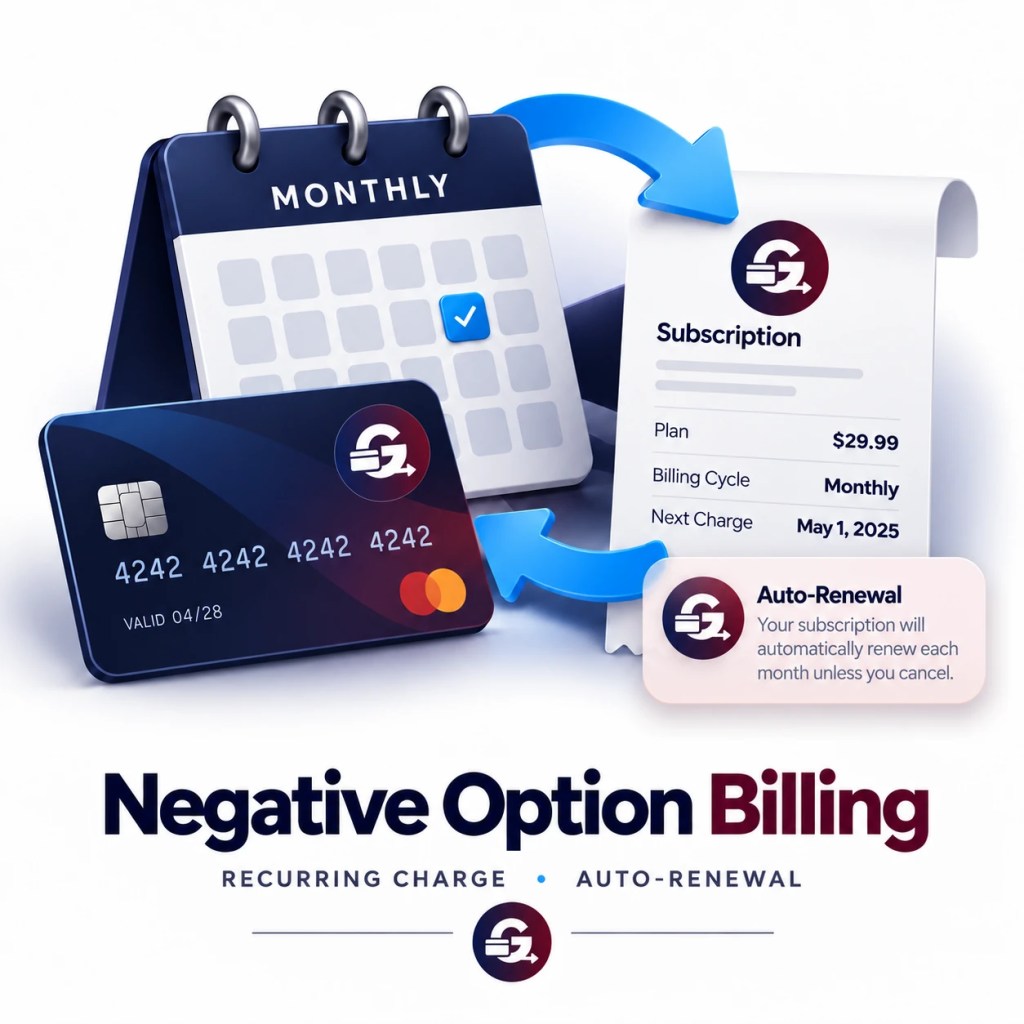
What Is Negative Option Billing?
A negative option is any offer where the customer’s silence counts as a yes. If they don’t cancel or decline, they get charged. The FTC groups negative option offers into four types:
Free-to-Pay Trials
A free or low-cost trial that converts to a paid plan unless the customer cancels.
Continuity Plans
Auto-ship programs that send and bill a new shipment on a schedule until cancelled.
Automatic Renewals
A membership or contract that renews for another term unless cancelled.
Prenotification Plans
Members are notified of each upcoming shipment and billed unless they decline it.
In one sentence: with a negative option, the burden is on the customer to say no. That’s why regulators and card brands watch these offers so closely.
Want Apple Pay and Google Pay on your continuity offers? Many can qualify. See recurring Apple Pay and Google Pay for high-risk subscriptions.
Negative Option vs. Standard Subscription Billing
Every negative option offer bills on a recurring basis, but not every subscription is a negative option. The difference is what the customer agreed to, and when.
Standard Subscription
The customer knowingly signs up for a paid plan.
- Chooses a monthly or annual plan
- Pays the full price on day one
- Is billed the same amount each cycle
- Cancels whenever they’re done
Negative Option Offer
The customer starts with a free or discounted offer.
- Accepts a free trial or low-cost first order
- Pays little or nothing up front
- Is billed full price unless they cancel in time
- Often doesn’t remember agreeing to the later charge
| Standard Subscription | Negative Option | |
|---|---|---|
| What triggers the charge | The customer’s decision to subscribe | The customer not cancelling |
| First charge vs. later charges | Usually the same price | Free or discounted first, then full price |
| Extra card brand rules | Recurring billing rules | Trial disclosures, reminders, and descriptor rules on top |
| Typical MCC | Depends on what’s sold | Often 5968, direct marketing continuity and subscription |
| Dispute risk | Moderate | Higher, especially at the first full-price charge |
| Underwriting | Standard or moderate risk | High risk, placed with banks that work with continuity offers |
Running a straightforward membership or SaaS plan? Our subscription and recurring billing page may fit you better.
Why Processors Treat Continuity as High Risk
Trial and auto-ship programs aren’t risky because they’re shady. They’re risky because of when the disputes show up:
- The first full-price charge lands weeks after sign-up, when customers have forgotten the offer
- Low-cost trials attract card testing and stolen cards
- One affiliate with misleading ads can spike disputes across your whole account
- Auto-ship disputes stack up, one per shipment, if a customer doesn’t notice
- Aggregators like Stripe and PayPal restrict or prohibit many trial offers
- Visa tightened its dispute monitoring threshold for U.S. merchants on April 1, 2026
What keeps accounts open: clear disclosures, real reminders, easy cancellation, and a fully disclosed backup merchant account with a second bank, so one review doesn’t stop your billing.

Visa and Mastercard Rules for Free Trials and Negative Option Offers
Both card brands have specific rules for trials that convert to paid subscriptions. Your acquirer is responsible for making sure you follow them.
Visa
In effect since April 2020, with a descriptor rule added in April 2021.
- Disclose the trial length, later charges, billing dates, and cancellation policy at checkout
- Get express consent to future charges, such as a click-to-accept button
- Email a confirmation, even for a $0 trial, that repeats the terms
- Send a reminder 7 days before the trial or promotion ends
- Mark the first post-trial charge with a descriptor that identifies the trial
Mastercard
In effect since September 22, 2022.
- Show the subscription terms at checkout and capture the cardholder’s acceptance
- Send a confirmation with the terms and cancellation instructions
- Remind customers 3 to 7 days before a trial ends
- For plans billed every six months or less often, remind 7 to 30 days before each charge
- Send a receipt after every charge and offer online cancellation
Why this matters in a dispute: for Visa misrepresentation claims on trials, the strongest evidence is proof that the customer expressly agreed to future charges, plus proof you sent the reminder at least 7 days before billing. Build both into your system from day one.
Summarized from published acquirer and processor guidance. Card brand rules change, so confirm current requirements with your processor.
Negative Option Rules: A Timeline Every Continuity Merchant Should Know
Federal, state, and card brand rules for negative option offers have changed a lot in the past few years. Here’s where things stand.
2010
ROSCA becomes law
The Restore Online Shoppers’ Confidence Act requires clear disclosure of terms, express informed consent before billing, and a simple way to stop recurring charges. It still applies today.
April 2020
Visa trial rules take effect
Disclosures, consent, confirmation emails, and 7-day reminders for free trials and introductory offers.
September 22, 2022
Mastercard subscription and trial rules take effect
Checkout terms, confirmations, trial reminders, and online cancellation.
July 1, 2025
California’s updated auto-renewal law takes effect
Separate consent to the auto-renewal, a click-to-cancel option online, annual reminders, and 7 to 30 days’ notice of price changes.
July 8, 2025
Court vacates the FTC’s click-to-cancel rule
The Eighth Circuit struck down the rule days before it took effect, on procedural grounds. ROSCA and state laws still apply.
March 11, 2026
FTC restarts negative option rulemaking
An advance notice asked for input on disclosures, consent, and whether to require click-to-cancel. Comments closed April 13, 2026. As of October 2026, no proposed rule has been published.
April 1, 2026
Visa’s dispute threshold tightens
Visa lowered the VAMP “excessive” threshold for U.S. merchants, so keeping disputes low matters more than ever.
This is general information, not legal advice. Confirm your obligations with qualified counsel. See the FTC’s ROSCA page and its March 2026 rulemaking announcement.
What a Compliant Negative Option Funnel Looks Like
Most continuity disputes can be traced back to one weak spot in the funnel. Here’s what acquirers expect to see at each step.
At Checkout
- Trial length, full price, and billing frequency next to the pay button
- A separate checkbox or click-to-accept for the recurring charge
- Cancellation policy in plain language
- No pre-checked boxes or hidden upsells
After Sign-Up
- Confirmation email with every term repeated
- Account page where customers can see their plan
- Billing descriptor customers will recognize
- Customer service contact on every email
Before Each Charge
- Trial-ending reminder on the card brand schedule
- Renewal reminders for long billing cycles
- Online cancellation that’s as easy as signing up
- Fast refunds for customers who missed the reminder
The affiliate problem: many continuity accounts are lost because of one affiliate running “free bottle, just pay shipping” ads that never mention the subscription. Your acquirer will hold you responsible for every traffic source, so review affiliate landing pages before they go live.
Continuity Chargebacks: Causes and How to Win Them
Here’s how the most common continuity disputes map to Visa dispute conditions.
| Visa Condition | Typical Trigger | Prevention and Evidence |
|---|---|---|
| 13.2 Cancelled Recurring | Billed after the customer believes they cancelled | Online cancellation, cancellation confirmations, and records showing the cancel date |
| 13.5 Misrepresentation | “I never agreed to a subscription” | Proof of express consent at checkout, plus the 7-day reminder |
| 10.4 Card-Absent Fraud | Stolen cards used on low-cost trial offers | AVS, CVV, 3D Secure, velocity limits, and blocking prepaid cards on trials |
| 13.1 Not Received | An auto-ship order didn’t arrive | Tracking numbers and delivery confirmation |
| 13.3 Not as Described | The product didn’t match the ad | Accurate ads and landing pages, including every affiliate page |
Rolling reserves are common on continuity accounts. Learn how they work and how to negotiate them in our guide to merchant account reserves, or read how to reduce chargebacks.
Continuity and Negative Option Businesses We Work With
Each model gets reviewed a little differently. Here’s what acquirers focus on.
Supplements & Nutraceuticals
Trial bottles and monthly auto-ship.
Underwriters look at: product claims, trial terms, and refund rates. See supplement merchant accounts.
Skincare & Beauty
Trial kits and replenishment plans.
Underwriters look at: before-and-after claims, shipping cadence, and cancellations.
Subscription Boxes
Curated monthly boxes with discounted first orders.
Underwriters look at: first-box discounts, skip options, and delivery tracking.
Digital Memberships & SaaS
Free trials that convert to paid access.
Underwriters look at: trial reminders, login records, and cancellation flow.
Online Courses & Coaching
Low-cost entry offers with recurring access.
Underwriters look at: income claims, upsells, and refund policy.
Pet & Household Auto-Ship
Recurring deliveries of everyday products.
Underwriters look at: shipping cadence, price changes, and easy skips.
How to Get a Continuity Merchant Account
Continuity files get a close look. Having these ready speeds things up:
- Business formation documents, owner ID, and bank statements
- Recent processing statements with refund and dispute rates
- Screenshots of your checkout, confirmation email, and reminder email
- Your terms, cancellation policy, and customer service contacts
- A list of traffic sources, including affiliates
Things that help: clear checkout disclosures, real reminders, easy cancellation, and low historical dispute rates.
Things that raise flags: hidden trial terms, aggressive affiliate offers, and no online way to cancel.
Ready to go? Start your continuity merchant account application. It takes about five minutes, and there’s no obligation.
Why Continuity Merchants Work With The Merchant Guru
Getting a continuity account approved is one thing. Keeping it under the dispute thresholds month after month is where we spend our time.
Banks That Underwrite Continuity
Acquirers that take trial and auto-ship offers on purpose. We underwrite up front, so we don’t turn accounts off for an unsupported business type.
Card Brand Rule Know-How
Visa and Mastercard trial rules built into your checkout and emails.
Backup Accounts, Done Right
A second fully disclosed account with another bank, so one review doesn’t stop your billing.
Transparent Pricing
Rates, reserves, and fees explained before you sign.
A Real Consultant
When ratios move, you call someone who already knows your file.
A Note from The Merchant Guru
I’ve worked with continuity merchants for a long time, and the ones who last all have the same thing in common: they make it easy for customers to understand what they signed up for, and easy to leave.
That sounds like it would cost you sales. In practice, it protects your merchant account, which is worth far more. My job is to match you with banks that understand your offer, and help you build a funnel that keeps your dispute ratio where it needs to be.
If you want a straight read on your program, even if the answer is “you’re fine where you are,” give me a call.
Russell Silva, Founder, The Merchant Guru
Continuity & Negative Option FAQs
Negative option billing is any offer where the customer is charged unless they take action to cancel or decline. Common examples are free trials that convert to paid plans, auto-ship continuity programs, automatic renewals, and prenotification plans.
With a standard subscription, the customer chooses a paid plan and pays the same price each cycle. With a negative option, the customer usually starts with a free or discounted offer and is charged full price later unless they cancel. That later charge is why negative option offers carry extra card brand rules and higher dispute risk.
Disputes tend to arrive at the first full-price charge, when customers have forgotten the offer. Low-cost trials also attract stolen cards, and affiliate ads can drive misleading sign-ups. Banks price and monitor that risk closely.
No. The Eighth Circuit vacated it on July 8, 2025. The FTC restarted negative option rulemaking in March 2026. ROSCA, state auto-renewal laws like California’s, and Visa and Mastercard rules all still apply.
Many use MCC 5968, direct marketing continuity and subscription merchants. Some acquirers code based on the product sold. The right code depends on your offer and your acquirer.
Visa requires a reminder 7 days before a trial or promotion ends. Mastercard requires one 3 to 7 days before a trial ends, and 7 to 30 days before each charge on plans billed every six months or less often.
Business documents, owner ID, bank statements, recent processing statements, screenshots of your checkout and emails, your terms and cancellation policy, and a list of your traffic sources.
Yes. We work with acquirers that underwrite free trials, auto-ship, and automatic renewals, and we help structure your funnel so it holds up to card brand rules.
It depends on how complete your file is. Same-day approvals are available on a case-by-case basis and are restricted to certain industries. Having your checkout screenshots, reminder emails and processing statements ready helps.
Disclose terms clearly at checkout, capture separate consent, send reminders on the card brand schedule, make online cancellation easy, use a recognizable descriptor, and review every affiliate landing page.
We underwrite up front, so we don’t turn accounts off for an unsupported business type. Your account still needs to follow card brand rules and keep disputes under control, and we help you do both.
No, and be wary of anyone who does. Nobody can guarantee an underwriting decision. What we can do is build your file the way continuity underwriters want to see it, before it ever reaches them.
Related Reading
Get a continuity merchant account built to last. Free trials, auto-ship, and automatic renewals, placed with banks that understand negative option offers.
No hidden fees. Terms clearly outlined in the merchant agreement. Because we underwrite up front, we don’t turn accounts off for an unsupported business type.
By submitting this form, you are acknowledging and consenting to our terms.
We do not distribute your information
