Licensed and bonded but still getting declined?
- 15+ years placing high-risk merchants
- 15+ low-risk and high-risk banking partners
- No long-term contracts and no hidden fees
- No sudden account freezes or terminations
- 4.9 Google rating
Prefer to talk? Call (818) 731-2227
Apply Now
By submitting this form you are consenting to our terms. We do not distribute your information.
The Credit Repair Organizations Act (CROA) sets the national rules for how credit repair companies sell, contract and bill, and it’s the first thing underwriters check on a credit repair merchant account. But CROA is only half your compliance picture. Most states add their own law on top, usually called a Credit Services Organization (CSO) act, and that’s where the registration forms, surety bonds and extra contract rules live.
The part that surprises people: these rules generally follow your client’s state, not yours. There’s no national license and no reciprocity between states. A company based in Texas that markets nationally can owe paperwork in a dozen places. Congratulations on your national reach. Here’s the bill.
Key takeaways
- State credit services laws usually apply where your clients live, so national marketing can trigger requirements in many states.
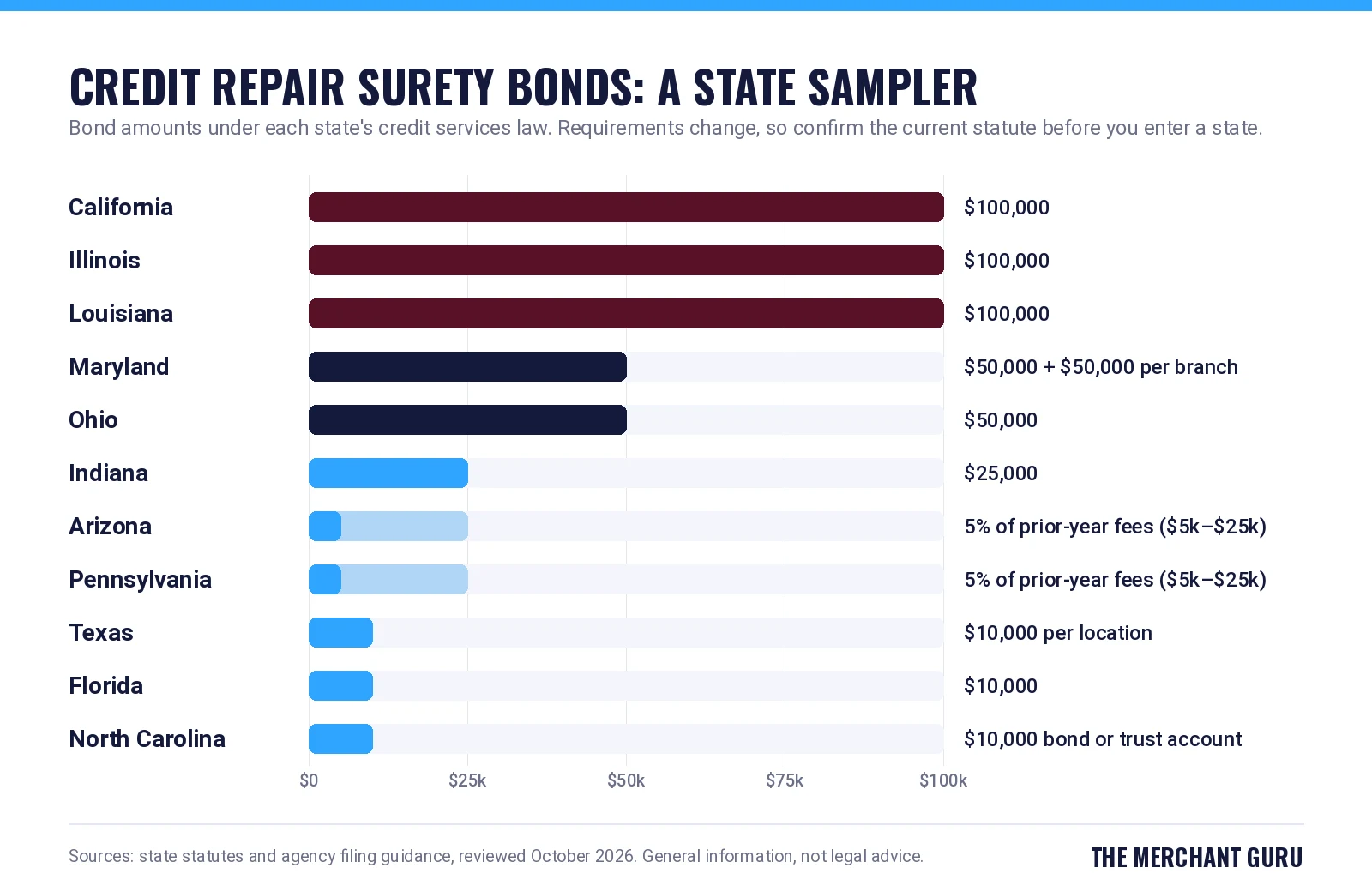
- Bond amounts range from $10,000 in states like Texas and Florida to $100,000 in California, Illinois and Louisiana. Arizona and Pennsylvania tie the bond to your prior-year fees.
- Some states go further. North Carolina bars collecting payment until services are fully performed, and Georgia has long restricted for-profit credit repair altogether.
- Underwriters check this paperwork. A complete licensing file speeds up approval and supports better account terms.
Why State Law Matters as Much as CROA
CROA covers the basics everywhere: written contracts, required disclosures, a three-day cancellation right and a ban on charging clients before the promised services are fully performed. If you telemarket, the Telemarketing Sales Rule adds its own payment timing rules. We cover both in When Can a Credit Repair Company Charge?
State laws build on that floor. They decide whether you need to register before taking a client, how much security you need to post, what extra language goes in your contract and, in a few states, whether you can operate for profit at all. Miss a state requirement and the problem isn’t only a fine. It can make your client contracts voidable, which turns into refunds and disputes. That’s an expensive way to learn a state capital.
The Three Things State CSO Laws Typically Require
1. Registration or licensure. Many states require you to file with a designated agency, often the Secretary of State or Attorney General, before soliciting clients there. Some, like Maryland, run licensing through NMLS. Registrations typically renew every year.
2. A surety bond or trust account. A surety bond is a three-party agreement between your company, the state and a surety carrier. If your company violates the state’s credit services law and a consumer is harmed, claims can be paid from the bond. In other words, it’s insurance for your clients, against you. Romantic, right? A few states, North Carolina among them, let you open a trust account instead.
3. Contract, disclosure and billing rules. State acts add their own required contract language, cancellation notices and, in some cases, stricter limits on when you can collect payment.
Surety Bond Requirements by State
Here’s a sampler of what state law requires. It isn’t every state, and amounts change, so treat it as a map, not a substitute for checking the current statute before you enter a state.
| State | Bond | Worth knowing |
|---|---|---|
| California | $100,000 | Filed with the Secretary of State. Must stay in force for two years after you stop doing business in the state. |
| Illinois | $100,000 | Register with the Secretary of State. The bond applies to firms that accept advance fees and stays in place two years after closing. |
| Louisiana | $100,000 | Annual registration with the Attorney General. |
| Maryland | $50,000 | Licensed by the Commissioner of Financial Regulation through NMLS. Each additional branch adds $50,000. |
| Ohio | $50,000 | Copy filed with the Division of Financial Institutions. Stays in force two years after closing. |
| Indiana | $25,000 | Filed with the Attorney General, which may accept a letter of credit instead. |
| Arizona | 5% of prior-year fees ($5,000 to $25,000) | The bond grows with your revenue up to the cap. |
| Pennsylvania | 5% of prior-year fees ($5,000 to $25,000) | Filed with the Department of State. |
| Texas | $10,000 per location | Filed with the Secretary of State. A separate bond is needed for each location, and it stays in place two years after you stop operating. |
| Florida | $10,000 | Required under the state’s credit service organization statute. |
| North Carolina | $10,000 bond or trust account | No payment until services are fully performed, and your contract must say whether you chose the bond or the trust account. |
Georgia is the outlier. Its approach to for-profit credit repair can be summed up as “please don’t.” Its law has long treated credit repair for payment as a misdemeanor, with narrow exceptions such as attorneys and 501(c)(3) nonprofits. Bills to change that have been introduced in recent sessions, so check the current law with your attorney before taking Georgia clients.
Bond, License or Registration: What’s the Difference?
These words get used interchangeably, but they’re separate steps. Registration tells the state you’re doing business there. A license is permission the state grants after reviewing you, and it usually comes with more paperwork. A bond is the financial guarantee behind either one. Most states that require a bond also require you to file it as part of registration, which is why the bond usually comes first. Different words, same theme: paperwork first, clients second.
What a Surety Bond Actually Costs
You don’t pay the full bond amount. You pay the surety carrier an annual premium, commonly quoted at 1% to 5% of the bond amount depending on your credit and financials. A $10,000 bond is a small line item. A $100,000 California or Louisiana bond is a real budget decision, and carriers often want business financials, not only a credit check, for larger bonds.
That cost is worth planning for when you decide which states to market in. Launching ads nationally and sorting out bonds later is how compliance debt builds up, and unlike your clients’ debt, you can’t dispute it.
Why Your Payment Processor Cares About This
Underwriters verify licensing. An application with registrations and bond certificates attached moves. One that triggers a “please provide” email sits. Operating unregistered in a state that requires it isn’t a slow file. It’s a decline with extra steps.
Your billing model has to match the law. Banks compare how you charge with what CROA and your clients’ states allow. If your contract bills before services are performed, expect hard questions, especially for clients in states like North Carolina.
Licensing is a credibility signal. Clean state compliance supports a better underwriting decision, which can show up in your processing limits and reserve terms.
Compliance gaps turn into disputes. A client who learns their contract may be voidable is a client who files a chargeback. Credit repair already draws scrutiny under Visa’s dispute monitoring, which we explain in Visa VAMP and Credit Repair. You can check where you stand with our chargeback ratio calculator.
Multi-state growth changes your risk profile. Banks have seen credit repair merchants grow faster than their licensing. Plan the compliance side of expansion and you keep your account through the growth.
Running a credit repair company? See how we set up credit repair merchant accounts →
Where Growing Credit Repair Companies Get Caught
- Marketing ahead of registration. Most CSO statutes attach when you solicit, not when you sign. A national ad campaign can create obligations in states you haven’t filed in yet. Yes, that Facebook ad running in Ohio counts.
- Forgetting the second location. Texas wants a bond per location, and Maryland adds $50,000 per branch. Opening an office means updating your filings.
- Letting renewals lapse. Registrations and bonds typically renew annually. A lapsed bond can mean you’re operating unregistered without realizing it.
- Using one contract everywhere. State acts add their own required language. A single national template rarely covers every state you serve.
A Practical Sequence for Getting It Right
- List every state where you have clients or actively market.
- Check each state’s CSO statute for registration, bonding, contract and payment rules. Your attorney should own this step.
- Get bonds in place before you register. Most states want the bond filed with the application.
- Update your client contract for each state’s required language and cancellation notice.
- Calendar every renewal date for registrations and bonds.
- Keep copies in your merchant account file. Your compliance folder is your best sales document when you apply.
The Merchant Guru’s Take
In credit repair, compliance and processability are the same project. The merchants we see approved quickly walk in with their registrations, bond certificates and a contract that matches how they actually bill. If you’re not sure your licensing will hold up to underwriting, we’re happy to look at it with you before you apply. Underwriters love a boring file. Be boring on paper and interesting everywhere else. You can also see how we set up credit repair merchant accounts.
Frequently Asked Questions
Do I need a bond in every state where I have clients?
Not every state, but many. Requirements generally follow where your clients live, so check each state you serve or market to. Some require a bond, some allow a trust account instead, and a few have no bond requirement at all.
Is a surety bond the same as insurance?
No. A bond protects consumers, not your company. If the surety pays a claim, it will generally look to you to repay it.
Does CROA require a surety bond?
No. CROA is federal and covers contracts, disclosures, cancellation rights and the ban on charging before services are fully performed. Bonds and registration come from state law.
How much does a credit repair surety bond cost?
You pay an annual premium, commonly 1% to 5% of the bond amount, based on your credit and financials. Larger bonds usually require more financial review.
Can I get a merchant account before I finish registering?
Underwriters generally expect registration and bond paperwork for the states you operate in. Applying with it ready is much faster than explaining why it’s missing.
This article draws on state statutes and agency filing guidance as of October 2026. It is general information, not legal advice. Confirm current requirements with a licensed attorney before entering a state.