Merchant Accounts by Industry
Merchant Accounts for Every Industry, Including the Ones Others Turn Down
In short
The Merchant Guru sets up merchant accounts for businesses at every risk level, from everyday retail, restaurants and professional services to high-risk and hard-to-place industries like CBD, vape, firearms, credit repair, travel and telemedicine. We work with 15+ banking partners and build each application around what your industry’s underwriters need to see.
Updated October 2026
Every industry has its own underwriting quirks. A CBD shop needs lab reports. A credit repair company needs state registrations. A travel agency needs to explain why customers pay today for a trip next spring. Put any of them on the wrong account and it’s only a matter of time.
If Stripe, Square or PayPal shut you down, you’re in good company. Many of the merchants we work with came to us right after an aggregator froze their account. We’ll explain what happened, then match you with a bank that knows your industry and approved it on purpose.
No hidden fees. Terms clearly outlined in the merchant agreement. A straight answer about your industry.
By submitting this form, you are acknowledging and consenting to our terms.
We do not distribute your information
Account Frozen? Let’s Talk Before You Apply Anywhere Else.
Tell us what happened. We’ll explain why, and find a bank built for your industry.
High-Risk Industries We Specialize In
Each of these industries has its own page covering what banks look for, common reasons for declines, and how we set up processing that lasts.
Regulated Products
Products With Rules
Age limits, lab testing, licensing and shipping restrictions shape underwriting here.
Financial Services
Money & Credit
Federal and state rules decide how and when you can charge, and banks check that first.
Travel & Hospitality
Pay Now, Travel Later
Future delivery means more exposure for the bank, so these accounts are built around timing.
Subscriptions, Health & Adult
Recurring & Sensitive
Recurring billing and card brand registration rules drive approval and stability.
Not high risk? We work with you too. Retail stores, restaurants, salons, professional services, B2B and eCommerce businesses get the same consultative approach, competitive pricing and a real person to call. See credit card processing for everyday businesses.
Special situations: MATCH / TMF listed merchants, startups with no processing history, and Apple Pay and Google Pay for recurring billing.
All Industries We Support
Don’t see yours? We work with more businesses than we can list, so call and ask. The worst thing we’ll say is “here’s who might.” Industries with a link have their own page.
- Accounting & Tax Prep
- Adult Content & Products
- Apparel & Clothing
- Automotive Sales, Service & Parts
- B2B Wholesale & Invoicing
- Bail Bonds
- Calling Cards
- CBD & Hemp
- Classified Websites
- Cleaning Services
- Collectibles & Memorabilia
- Construction & Contractors
- Continuity & Negative Option Billing
- Credit Repair
- Debt Collection & Collection Agencies
- Debt Consolidation
- Debt Settlement
- Digital Downloads (eBooks, Software)
- Document Preparation
- Drop-Shipping
- Educational Seminars & eLearning
- Electronics
- Firearms, Guns & Ammo
- Franchise & Multi-Location
- Hair & Beauty Salons
- Health & Fitness
- Healthcare & Clinics
- High-End & Online Furniture
- High-Ticket Sales
- High-Volume Merchants
- Hotels & Hospitality
- Hunting & Outdoors
- Insurance
- Jet Charter
- Kratom & Kava
- Law Firms
- Loan Modification
- Marketing, SEO & SEM Services
- MATCH / TMF Merchants (case by case)
- MLM (Multi-Level Marketing)
- Money Services Businesses (MSB)
- Moving & Transportation
- Non-Profit & Higher Education
- Nutraceuticals & Supplements
- Online Dating
- Online Gaming & Casinos (where allowed)
- Online Pharmacy
- Pawn Shops
- Peptides (B2B, processing history required)
- Prop Trading Firms
- Property Management
- Real Estate
- Restaurants & Bars
- Retail
- SaaS (Software as a Service)
- Self-Defense Equipment
- Smoking Accessories
- Sports Picks & Betting Advice
- Startups
- Subscription Businesses
- Tech Support
- Telemedicine
- Ticketing & Events
- Timeshares
- Tobacco
- Travel Agencies
- Utilities
- Vacation Clubs
- Vape & E-Cig
- Web Design & Agencies
- Wine, Liquor & Alcohol
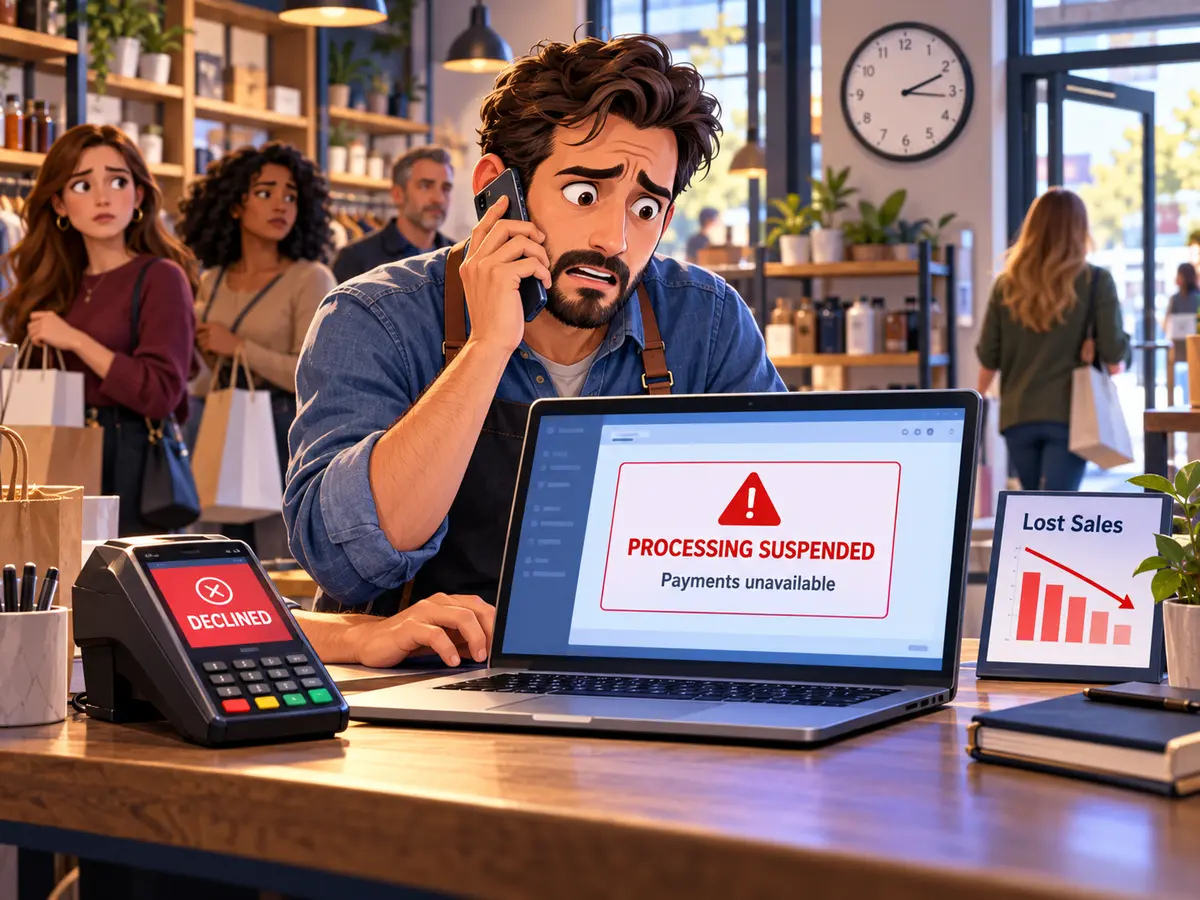
Shut Down by Stripe, Square or PayPal? Here’s Why
Stripe, Square and PayPal are payment aggregators. They approve almost anyone in minutes under a shared account, then review you later. When their automated risk checks spot an industry on their restricted list, a jump in volume or a spike in disputes, they can close the account and hold your funds. It isn’t personal. It’s the business model.
What to do next:
- Don’t open a new aggregator account under a different name. It usually gets caught, and the next hold is longer.
- Save the shutdown notice and download your recent processing history.
- Get a dedicated merchant account that’s underwritten for your industry before you take a single payment.
- Talk to us before you apply anywhere else, so you only tell your story once.
Stripe, Square & PayPal vs. Your Own Merchant Account
Payment aggregators are great at one thing: getting a small, low-risk business taking cards in minutes. The trade-off shows up later. Here’s how the two setups compare:
| Stripe, Square & PayPal (aggregators) | Your own merchant account | |
|---|---|---|
| How you’re approved | Instant sign-up, with the real review happening after you start processing | Underwritten before you take a single payment |
| Your account | One of many businesses under the aggregator’s shared account | Your own merchant ID (MID) with a bank that knows your business |
| High-risk industries | Many are on restricted lists, even if you were approved at sign-up | Approved on purpose by a bank that works with your industry |
| When volume spikes | Can trigger an automatic review, a hold or a closure | Your expected volume is approved up front, and it can be raised with your bank |
| If something goes wrong | Funds can be held for months, often with little explanation | Reserve and hold terms are disclosed before you sign |
| Support | Help center and ticket queues | A consultant who knows your account and picks up the phone |
| Best for | New, low-volume, low-risk businesses getting started | Growing, established or high-risk businesses that need stability |
Nothing wrong with starting on an aggregator. The problem is staying on one after your business outgrows it, or starting on one in an industry it was never built for.
The Real Cost of the Wrong Setup
Your rate is the cost you can see. The expensive part of a bad setup usually shows up later, all at once, and on a Friday.
Fast and easy isn’t always better. Instant-approval accounts are built for speed, not for your industry. They feel great on day one and can fall apart the day your volume grows or a few disputes come in.
And yes, cost matters. We get it, and we’re always competitive on pricing, with every rate and fee shown before you sign. But your rate is only one factor. The right bank for your industry, stable terms, chargeback tools and a real person to call matter just as much, because getting any of them wrong can do far more damage than a slightly higher rate.
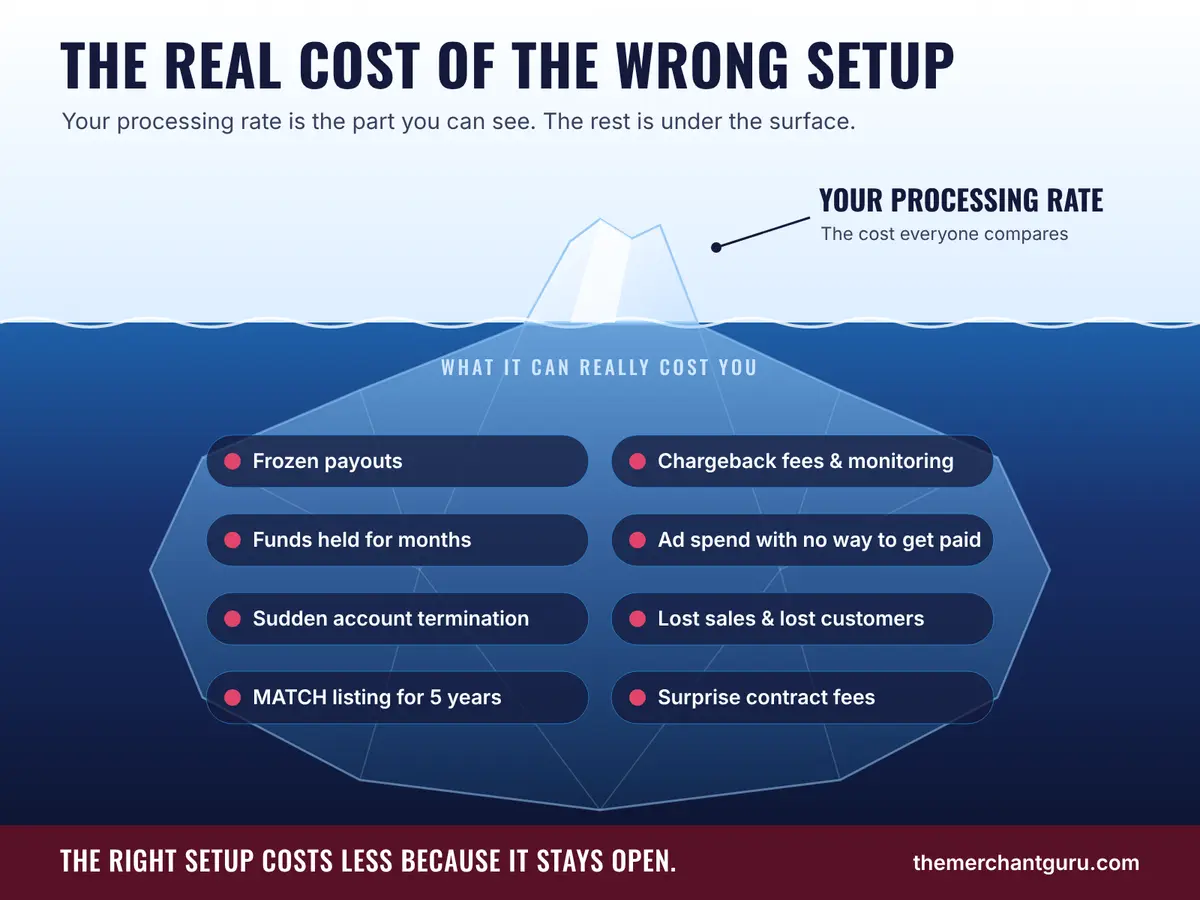
| The wrong setup | What it can cost you |
|---|---|
| An aggregator account in a high-risk industry | A sudden shutdown, funds held for weeks or months, and sales that stop overnight |
| The wrong business category (MCC) or description | Termination for misrepresentation, and possibly a MATCH listing that follows you for five years |
| No chargeback prevention | Card brand monitoring programs, per-dispute fees, higher reserves, then a termination letter |
| One account and no backup | One bank decision and your revenue stops until you find a new home |
| The wrong pricing model | Overpaying on every transaction, quietly, for years |
| A website or billing model that fails underwriting | Declines, delays and repeat applications, each one a new paper trail |
| Contract terms nobody explained | Early termination fees, equipment leases and surprise charges on your statement |
Here’s the math nobody shows you: one frozen payout can wipe out years of savings from a cheaper rate. The right setup costs less over time because it stays open.
Check your numbers with our free tools:
 Free ToolEffective Rate CalculatorSee what you’re really paying per dollar processed, fees and all.Calculate your rate →
 Free ToolChargeback Ratio CalculatorCheck your dispute ratio against Visa and Mastercard monitoring thresholds.Check your ratio →
Already terminated? Read about merchant accounts for MATCH-listed businesses.
I’ve seen it all. One merchant came to me after spending $50,000 on a marketing campaign. The campaign worked. Volume spiked, and because the account was never set up for that kind of growth, the processor froze it and then terminated it. All that new traffic was landing on a site that couldn’t take a single payment. Money down the drain.
That’s why who you process with matters so much. You need a partner who understands not just credit card processing, but your specific industry. And even inside one industry, no two businesses are the same. Two supplement brands can look identical on paper and still need completely different setups because of how they bill, ship and market. Those caveats are exactly why we work as consultants instead of pushing one application at everybody.
If you’re planning a big push, a new product or a jump in volume, call me before you launch, not after the freeze.
Russell Silva, Founder, The Merchant Guru
Backup Accounts and Split Volume (Multi-MID)
Running your whole business on one merchant account is like having one key to your store. Works great, right up until you lose it. Because we work with 15+ banking partners, we can set you up with more than one merchant account (MID) when it makes sense for your business, either as a backup or to share your volume across banks.
Relationships Before You Need Them
If one account is closed or paused, you already have a second bank that knows you. No frantic search, and no starting from scratch while sales sit still.
Keep Selling During a Hold
If one bank places a hold or asks for a review, you can move volume to your other account while you sort out the concern.
Room to Grow
Sharing volume across banks lets you scale, run a big campaign or add products without outgrowing a single account.
Done the right way: every account is fully disclosed and underwritten on its own, and each bank knows what you sell. Splitting sales just to keep chargeback ratios under card brand limits breaks card brand rules and is a fast route onto the MATCH list. We set up multiple accounts for stability and growth, never to hide anything.

Your Industry Decides Which Bank Says Yes
Every bank has its own list of industries it approves, avoids or approves only with conditions. The same business can be declined at one bank and welcomed at another. Knowing which is which is most of the job.
- CBD and hemp: certificates of analysis and compliant labels
- Vape and tobacco: age verification and state shipping rules
- Firearms: federal licensing and a clear view of what you sell
- Credit repair: state registrations, bonds and billing that follows federal law
- Travel: seller of travel registration where required, and how far ahead customers pay
We know what each industry’s underwriters will ask, so your application answers it before they do.
What Underwriters Look For, by Industry
Every industry gets its own set of questions. Here’s a cheat sheet of what banks commonly ask for, and the mistakes we see sink applications most often. Show up with the left column and avoid the right, and you’re already ahead of most applicants.
| Industry | What banks commonly ask for | Common reasons for a decline |
|---|---|---|
| Retail & everyday businesses | Owner ID, business documents and a voided check or bank letter. Usually the simplest file. | Mismatched business information or personal credit concerns |
| CBD & hemp | Third-party lab reports (COAs) for each product, compliant labels, a clear product list | Missing lab reports, medical claims on the website, products over the federal THC limit |
| Kratom & kava | Product list, supplier information, an age policy and a list of states you ship to | Shipping into states or cities that ban kratom, health claims |
| Vape & tobacco | Age verification at checkout, state licenses, PACT Act compliance for online sales | No age verification, shipping to restricted states |
| Firearms & ammo | Federal firearms license (FFL) where required, product catalog, compliant shipping policy | An unclear product mix or missing licenses |
| Supplements | Product labels, ingredient lists, refund and shipping policies, how you bill customers | Free-trial or negative-option billing, unsupported health claims, high refund rates |
| Credit repair | State registrations and bonds, client contracts, billing only after services are performed | Charging upfront fees, which federal law prohibits, or missing state bonds |
| Debt settlement | State licenses and a fee structure that follows the FTC Telemarketing Sales Rule | Collecting fees before a debt is settled, missing licenses |
| Money services businesses | FinCEN registration, state money transmitter licenses, a written AML and KYC program | No anti-money-laundering program, missing licenses |
| Prop trading firms | A clear explanation of evaluation fees, payout rules and refund policy | Unclear payout terms, marketing that reads like investing or gambling |
| Travel | Seller of travel registration in states that require it, booking-to-travel timelines, supplier relationships | Long gaps between payment and travel with no processing history |
| Telemedicine | Licensed providers, prescription policies, LegitScript certification when prescriptions are involved | No physician oversight, selling prescriptions without certification |
| Subscriptions & continuity | Clear billing disclosures, simple cancellation, trial terms that follow card brand rules | Hidden terms, hard-to-cancel billing, high chargebacks |
| Adult | Age and consent verification, content moderation policies, card brand registration | Missing content controls or registration |
A general guide, not legal advice. Requirements vary by bank, state and how your business sells, and your consultant will tell you exactly what your bank needs.
How It Works
Have these ready and the process moves faster:
- Business formation documents and owner ID
- A voided check or bank letter
- Your last three to six months of processing statements, if you have them
- Your website, with policies and pricing visible
- Industry documents, like licenses, registrations or lab reports
Ready? Start your application. It takes about five minutes, and there’s no obligation.
What You Can Expect From The Merchant Guru
If it doesn’t work, it doesn’t matter. We’d rather place you once and correctly than quickly and twice.
Industry Know-How
We know what your industry’s underwriters look for, and we build your file around it.
15+ Banking Partners
Banks that approve high-risk industries on purpose, not by accident.
Approvals That Stick
Full disclosure up front, so your account isn’t a surprise to the bank later.
Transparent Pricing
Every rate, fee and reserve term explained before you sign.
A Real Consultant
One point of contact who knows your account and picks up the phone.
Merchant Accounts by Industry: FAQs
Standard businesses like retail, restaurants and eCommerce, plus high-risk industries such as CBD, kratom, vape, tobacco, firearms, supplements, adult, credit repair, debt settlement, prop trading, money services, bail bonds, travel, hotels, timeshare, vacation clubs, telemedicine and subscription billing. The full list is on this page.
No. We work with low-risk and retail businesses too, including retail stores, restaurants, salons, professional services and B2B companies. Every merchant gets the same consultative approach, competitive pricing and a real person to call. High risk is simply where a lot of processors stop helping, so it’s where we’re best known.
Banks label an industry high risk when it carries more chargebacks, regulation, future delivery, recurring billing or reputational concern for the card brands. It’s about the bank’s exposure, not a judgment about your business.
Probably. We work with more industries than we list. Call us at (818) 731-2227 and tell us what you sell. If we can’t place you, we’ll tell you who might.
Yes. Many of the merchants we work with came to us after an aggregator shutdown. We’ll look at what happened and match you with a bank that underwrites your industry up front.
Aggregators approve quickly under a shared account and review later. If your industry is on their restricted list, or your volume or disputes change suddenly, their automated risk checks can close the account and hold funds.
No account is immune, but a dedicated merchant account is underwritten before you process, with your industry fully disclosed. That makes it far more stable than an aggregator, as long as chargebacks and your billing practices stay healthy.
Yes. Many high-risk merchants keep a second merchant account as a backup, or split volume across two banks so one hold or closure doesn’t stop their sales. Each account is underwritten separately with your business fully disclosed. Using multiple accounts to keep chargeback ratios artificially low breaks card brand rules, so we set them up for stability, not to hide disputes.
Usually, because the bank takes on more risk. Your actual pricing depends on your industry, history, volume and how you sell. We explain every rate, fee and reserve term before you sign.
Most applications need owner ID, a voided check or bank letter, recent processing statements if you have them, and a website with clear policies. Many industries also need licenses, state registrations or lab reports.
Often, yes. Some banks review MATCH-listed merchants case by case. We start with an honest look at why the termination happened and what has changed.
No, and be wary of anyone who does. Approval is the bank’s decision. What we can do is match you with the right bank and build an application the way its underwriters want to see it.
Helpful Guides and Tools
Get a merchant account built for your industry. Everyday retail, high-risk, hard-to-place or just shut down by an aggregator, we’ll match you with a bank that approves your business on purpose.
Terms clearly outlined in the merchant agreement. No hidden fees. No guaranteed-approval nonsense, just honest answers.
By submitting this form, you are acknowledging and consenting to our terms.
We do not distribute your information