Subscription Merchant Accounts & Recurring Billing Processing
Payment Processing for Subscription, Membership & Recurring Revenue Businesses
In short
The Merchant Guru sets up subscription merchant accounts for recurring billing businesses, from memberships and subscription boxes to software. We get card-on-file billing, card brand renewal rules and Apple Pay and Google Pay subscriptions right from day one, with one of our 15+ banking partners.
Updated October 2026
Subscription businesses get flagged by banks before they ever process a transaction. Small tickets, high volume, and customers who forget they signed up add up to a dispute profile that makes underwriters nervous, and many mainstream processors decline the category outright or shut accounts down once volume climbs.
We place subscription and recurring billing merchants with acquirers that understand the model, and we set you up with Apple Pay and Google Pay for recurring billing, something high-risk subscription merchants have struggled to get for years. 15+ years in high-risk payments means we know what underwriters look for before you apply.
No hidden fees. Terms clearly outlined in the merchant agreement. Just a straight read on your subscription processing options, including digital wallets.
By submitting this form, you are acknowledging and consenting to our terms.
We do not distribute your information
Built for Enrollment Fees and Years of Dues Billing
Vacation clubs run on a hybrid model: a large upfront fee followed by recurring membership dues. The account needs to support both sides of that billing structure without triggering a flag.
Declined, Frozen, or Dropped by Stripe or PayPal?
Aggregators approve subscription businesses fast and review them later, often right when renewals start stacking up. Don’t wait on the form. Call us for a straight read on your options.
How Processors Underwrite Subscription Businesses
A subscription merchant asks the processor to approve one charge today and then trust you to bill that card again, without the customer present, for months or years. That’s why underwriters look past your volume and focus on four things:
- Card-on-file billing. After the first checkout, every renewal is a merchant-initiated transaction. Underwriters want proof the customer agreed to that up front.
- Dispute count, not dispute dollars. Card-network monitoring programs count disputes per transaction. A $9.99 plan can hit a dangerous ratio long before the dollar amounts look scary.
- Trial and renewal practices. Free trials, auto-renewals, and price changes are where most “I didn’t authorize this” disputes come from.
- Your merchant category code. Many subscription merchants are coded MCC 5968 (Direct Marketing – Continuity/Subscription), which tells every bank in the chain to watch your billing practices closely.
What the underwriter is really asking: “When a customer forgets about this subscription, will this merchant’s disclosures, reminders, and cancellation flow stop a dispute before it happens?”
Subscription Businesses We Work With
If you bill customers on a schedule, we can likely help. Every account is structured around how your specific model renews, cancels, and disputes.
SaaS & Software
- Monthly and annual plans
- Usage-based and tiered billing
- B2B and B2C software
Memberships & Clubs
- Membership sites and communities
- Fitness and online coaching
- Paid newsletters and content
Subscription Boxes
- Physical product subscriptions
- Replenishment and refill programs
- Curated and gifting boxes
Higher-Risk Recurring
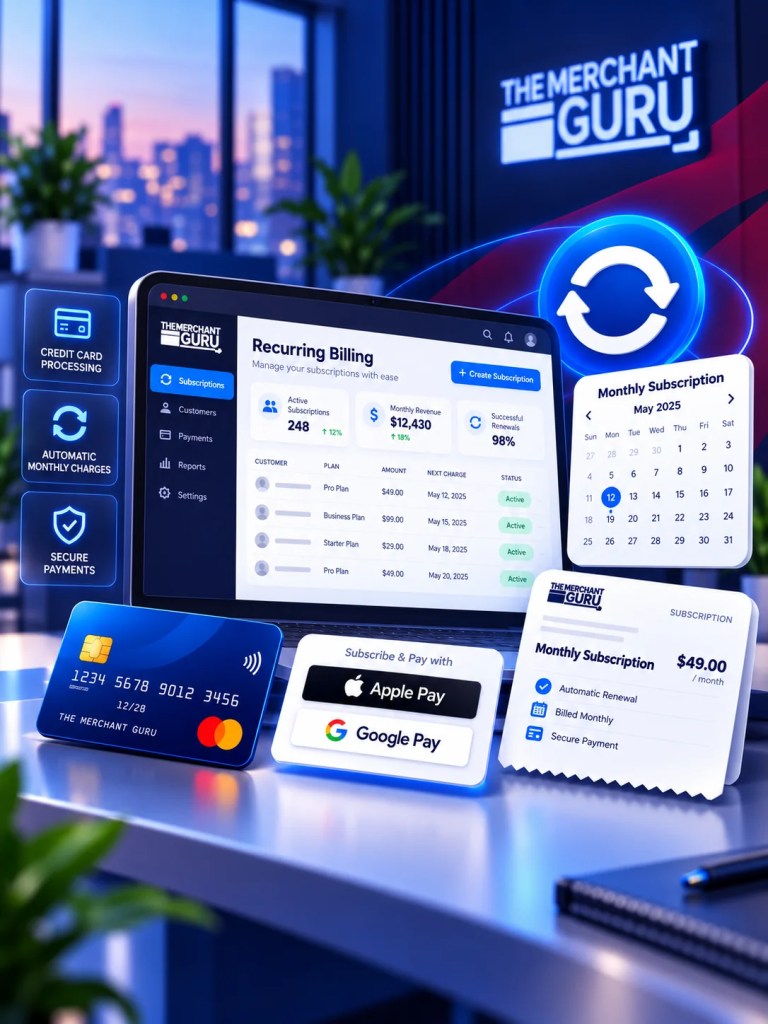
Apple Pay & Google Pay for Subscription Billing
Digital wallets are where subscription checkouts are heading, and for a long time high-risk subscription merchants were locked out of them. Aggregators like Stripe support wallets but drop high-risk accounts. Many high-risk processors approved the account but couldn’t handle wallet payments for recurring billing. We set up both.
- Apple Pay and Google Pay at checkout for new subscribers
- Wallet credentials stored for future merchant-initiated renewals
- Apple Pay merchant token (MPAN) support where the issuer supports it
- Network tokens that update automatically when cards are reissued
- Biometric authentication at signup to help cut card-not-present fraud
- A gateway and processor setup confirmed to handle recurring wallet payments before you launch
Why this matters for conversion: a one-tap wallet checkout means no card typing on a phone screen. For subscription offers sold on mobile, that’s often the difference between a new subscriber and an abandoned cart.

Why Wallet Subscriptions Fail, and How to Keep Them Billing
When wallet subscriptions break, it usually comes down to one of two things: a payment setup that was never built to support wallets for your business type, or a stored wallet token that stops working after the first charge. Both are fixable, but only if you catch them before your renewals start failing.
Reason #1: Your Gateway or Processor Isn’t Set Up for It
Not every gateway or processor supports Apple Pay and Google Pay for recurring billing. Supporting a wallet button at checkout is one thing. Storing that wallet credential and charging it again next month, as a merchant-initiated transaction, is another, and the gateway, the processor, and the acquiring bank all have to support it.
This is where a lot of high-risk subscription merchants get stuck. We regularly talk to merchants who started on Stripe, couldn’t get wallets working for their business type no matter how they integrated, and lost weeks trying. Stripe, Square, PayPal, and other aggregators publish lists of restricted and prohibited business types. If yours is on that list, wallet payments are the least of your worries, because the whole account is at risk.
Where It Goes Wrong
- Your business type is restricted or prohibited on an aggregator like Stripe or Square, so features get limited or the account gets reviewed
- Your high-risk processor approves the account, but its gateway can’t store wallet credentials for renewals
- The first wallet charge works, but renewals fail because they aren’t sent as proper recurring transactions
- Apple Pay merchant registration and domain verification were never completed with the right provider
What the Right Setup Looks Like
- An acquirer that approves your business type for card-not-present recurring billing
- A gateway that supports Apple Pay and Google Pay for both the first checkout and stored-credential renewals
- Apple Pay merchant tokens (MPANs) and network tokens enabled
- A test of the full cycle, signup, renewal, and decline handling, before you launch to real subscribers
Moving off Stripe or Square? Plan the switch before you’re forced into it. Stored card numbers can usually be migrated to a new PCI-compliant provider, but wallet credentials often can’t be moved the same way, so some subscribers may need to re-enter a payment method. We help you map out the migration so renewals don’t drop off a cliff.
Reason #2: Device Tokens That Break When Phones Change
Even with the right setup, there’s a second problem most merchants find out about the hard way. By default, Apple Pay creates a device token (DPAN) that’s tied to one specific phone. If your subscriber upgrades their iPhone or removes the card from their wallet, that token may stop working, and the next renewal declines even though the customer never meant to cancel.
| Credential | What It’s Tied To | What Happens When the Customer Gets a New Phone | Best For |
|---|---|---|---|
| Raw card number (traditional card on file) | The physical card | Nothing, until the card expires or is reissued | Legacy checkouts; needs account updater |
| Apple Pay device token (DPAN) | One device | May stop working, so renewals can fail | One-time purchases |
| Apple Pay merchant token (MPAN) | The customer, the card, and your business | Keeps working across device changes | Subscriptions, auto-reloads, deferred charges |
| Network token (Visa / Mastercard) | The card account, managed by the network | Keeps working, and updates automatically when cards are reissued | Any card-on-file billing |
The fix: request Apple Pay merchant tokens for recurring payments. Your checkout passes a recurring payment request (a description, the billing amount and interval, and a link where the subscriber can manage the plan), and Apple returns an MPAN when the card issuer supports it. That management link also lines up neatly with the card networks’ easy-cancellation rules.
Wallet eligibility isn’t only your processor’s call. Apple’s acceptable use guidelines for Apple Pay on the web exclude certain categories regardless of who processes your cards, including tobacco and vaping products, firearms, pornography, and currency or crypto purchases without Apple’s approval. We’ll tell you up front whether wallets are realistic for your offer.
Want the technical deep dive? See our guide to Apple Pay and Google Pay recurring billing.
Visa and Mastercard Rules Every Subscription Merchant Should Know
Both card networks publish specific requirements for subscription and recurring billing. Processors check for them during underwriting, and issuers use them to decide disputes.
Visa
For subscriptions that start with a free or discounted trial, Visa requires merchants to:
- Get the cardholder to “expressly consent to entering an ongoing subscription service”
- Disclose the trial length, the amount, and the billing date
- Send an electronic reminder at least 7 days before the first post-trial charge
- Offer online cancellation regardless of how the customer signed up
- Flag the transaction as recurring and identify the trial in the first post-trial descriptor
Mastercard
For subscription and recurring-billing merchants, Mastercard requires:
- Clear subscription terms at the point of payment, with the cardholder’s acceptance captured
- A confirmation email at enrollment
- A receipt after every billing, with clear cancellation instructions
- An online or electronic cancellation method
- For billing cycles of 180 days or more, a reminder 7 to 30 days before the charge
Annual plans are the sleeper risk. Under Mastercard’s rules, any plan billed every 180 days or more needs a reminder 7 to 30 days before the renewal. Skip it, and the customer who forgot about last year’s purchase becomes a chargeback.
Visa’s guidance on cancelled recurring transactions (dispute condition 13.2) tells merchants to check customer logs “daily for cancellation or non-renewal requests” and confirm in writing when a recurring account is closed. Running free or low-cost trials? Our continuity and negative option billing page covers trial rules in depth.
Failed Payments: Recover Revenue Without Breaking Network Rules
Involuntary churn, meaning subscribers lost to expired cards and declines rather than cancellations, quietly drains recurring revenue. Recovering it takes the right tools and retry discipline, because both networks penalize merchants who retry the wrong declines.
Account Updater
- Visa Account Updater and Mastercard Automatic Billing Updater refresh stored card numbers and expiration dates
- Fewer renewals declined for expired or reissued cards
Network Tokens
- Card credentials managed by Visa and Mastercard
- Update automatically, often with higher approval rates on stored-card billing
Smart Retries
- Visa allows up to 15 reattempts in 30 days on recoverable declines
- Visa prohibits retrying “never approve” decline codes, and charges fees when merchants do
- Mastercard merchant advice codes flag when not to retry, such as a cancelled recurring payment
Retrying a “do not retry” decline doesn’t just cost a fee. If the customer cancelled with their bank, every extra attempt is a fresh chance for a dispute. A good retry setup reads the decline reason before it tries again.
Subscription Chargebacks and the Monitoring Programs That Track Them
Most subscription disputes come from a handful of predictable situations. Here’s how they map to Visa’s dispute conditions and what wins them.
| Visa Condition | What the Customer Claims | Typical Subscription Trigger | Your Best Defense |
|---|---|---|---|
| 13.2 Cancelled Recurring | “I cancelled and you kept charging me.” | Renewal after a cancellation request, or no reminder before an annual charge | Cancellation logs, reminder emails, and accepted terms |
| 10.4 Card-Absent Fraud | “I didn’t authorize this.” | Customer doesn’t recognize the descriptor, or a family member signed up | Visa Compelling Evidence 3.0: prior undisputed transactions with matching device and account data |
| 13.1 Not Received | “I never got access.” | Login problems, failed deliveries, or a box that never arrived | Access logs, usage history, and delivery confirmation |
| 13.3 Not as Described | “This isn’t what was advertised.” | Features or contents that don’t match the offer | Checkout screenshots, plan descriptions, and terms |
| 12.6 Duplicate Processing | “I was charged twice.” | Retry logic or plan changes that double-bill | Transaction records showing separate, valid charges |
Visa VAMP
- Ratio: fraud reports plus disputes, divided by settled transactions
- Excessive: a set ratio and monthly event count, tightened in the US, Canada, Europe and Asia Pacific on April 1, 2026
Mastercard ECP
- Ratio: this month’s chargebacks divided by last month’s transactions
- Excessive: a set monthly chargeback count and ratio; High Excessive: a higher tier with stricter consequences
Stop disputes before they count. Pre-dispute tools like Visa’s Rapid Dispute Resolution and Order Insight, and Mastercard-network alerts through Ethoca, let you refund or resolve a case before it becomes a chargeback. A clear billing descriptor with your brand name and a support phone number prevents a surprising number of “I don’t recognize this” disputes on its own.
Check where you stand with our chargeback ratio calculator, or see how we help with chargeback mitigation and VAMP consulting.
Beyond the Card Networks: ROSCA and State Auto-Renewal Laws
Card-network rules aren’t the only ones underwriters check. Federal and state auto-renewal laws apply too, and they’ve been moving fast.
- The FTC’s “click-to-cancel” rule was vacated by the Eighth Circuit in 2025, and the FTC opened a new rulemaking in March 2026. It isn’t gone. It’s being rewritten.
- ROSCA (the Restore Online Shoppers’ Confidence Act) is still federal law. It requires clear disclosure of material terms, express informed consent before billing, and a simple way to cancel, and the FTC continues to enforce it.
- State auto-renewal laws, led by California, add their own consent, reminder, and online-cancellation requirements, and they apply based on where your customers live.
The practical takeaway: if your checkout meets Visa and Mastercard’s subscription rules (express consent, clear terms, reminders, and easy online cancellation), you’re most of the way to meeting these laws too. We review your flow against all of it before an underwriter does.
Where these rules come from: Visa: Cancelled Recurring Transaction, Condition 13.2 · Mastercard: Subscription and Negative Option Billing Model Summary · Apple: Apple Pay Merchant Tokens · Apple: Acceptable Use Guidelines for Apple Pay on the Web. Card-network rules and auto-renewal laws change often. This page summarizes publicly available guidance as of October 2026 and isn’t legal advice.
What Subscription Underwriters Ask For and How We Set Up Your Account
Subscription files are judged on how you sign up, bill, and cancel customers. Expect to be asked for:
- Business formation documents and ID for each owner
- Recent business bank statements and prior processing statements
- Your terms of service, cancellation, and refund policies
- Screenshots or a test login for your checkout and cancellation flow
- Sample confirmation, receipt, and renewal reminder emails
- Churn, refund, and chargeback history, if you’re already billing
Things that help: a checkbox or clear consent step for recurring billing, renewal reminders, one-click online cancellation, a recognizable billing descriptor, and a low dispute history.
Things that raise flags: trials that convert without clear disclosure, cancellation only by phone, no reminders before annual renewals, and a history of disputes after price increases.
Ready to go? Start your subscription merchant account application. It takes about two minutes, and there’s no obligation.
Why Subscription Businesses Work with The Merchant Guru
We’re consultants, not a processor. We help subscription and membership businesses find acquiring banks that board recurring billing on purpose, then build the account around how you actually renew customers.
Apple Pay & Google Pay Included
Digital wallets for subscription billing, set up correctly with merchant tokens and recurring support, even for high-risk models.
We Speak Card-Network Rules
Trial disclosures, reminder timing, cancellation requirements, and dispute conditions are the language underwriters use. Your file will speak it.
Less Involuntary Churn
Account updater, network tokens, and rule-compliant retries keep renewals going through when cards change.
Placed for Stability, Not Speed
A fast yes from a processor that drops subscriptions at the first dispute spike doesn’t help you. We match you with acquirers that understand recurring revenue.
Someone Who Picks Up the Phone
When renewals spike disputes or volume jumps, you get a direct line to a consultant who already knows your file.
A Note from The Merchant Guru
For years, high-risk subscription merchants had to pick one: an account that would actually approve them, or a checkout with Apple Pay. That was a real cost, because so many subscriptions are sold on a phone.
I’ve spent 15+ years in payments, and the part I care about getting right is the whole picture: an acquirer that understands recurring billing, a checkout that follows the card-network rules, and wallets that keep renewing after your customer upgrades their phone.
If you want a straight read on your options, even if the answer is “you’re fine where you are,” give me a call.
Russell Silva, Founder, The Merchant Guru
Subscription Merchant Account FAQs
Banks classify recurring billing merchants as high-risk mainly because of chargeback exposure. Customers frequently dispute charges they forgot about or do not recognize, and the sheer transaction volume of a subscription model amplifies that risk compared to a one-time purchase business.
Yes. We set up merchant accounts and gateways that support Apple Pay and Google Pay for both the first checkout and future recurring charges. For Apple Pay, we recommend requesting merchant tokens (MPANs), which stay valid when a subscriber changes phones. Some categories are excluded by Apple’s own guidelines, and we’ll tell you up front if that applies to you.
By default, Apple Pay issues a device token (DPAN) tied to one phone. If the customer replaces the device or removes the card, that token may stop working and the next renewal can decline. Apple Pay merchant tokens (MPANs) are tied to the customer, card, and your business instead of the device, so they keep working.
Usually it’s one of two things. Either your business type is restricted or prohibited on that platform, so the account itself is limited, or the integration only supports wallets for one-time payments, not stored-credential renewals. The fix is a merchant account approved for your business type, paired with a gateway that supports wallet payments for recurring billing. We set that up and test the full signup-to-renewal cycle before launch.
Both networks expect clear terms and express consent at signup, an easy online cancellation method, and transparent billing. Mastercard requires a confirmation at enrollment, a receipt after every billing, and a reminder 7 to 30 days before charges on plans billed every 180 days or more. Visa requires a reminder at least 7 days before the first charge after a free or discounted trial.
Use account updater services and network tokens so stored cards stay current, and use retry logic that reads decline codes. Visa allows up to 15 reattempts in 30 days on recoverable declines but prohibits retrying certain decline codes, and Mastercard’s merchant advice codes signal when not to retry.
The Visa Acquirer Monitoring Program tracks fraud reports plus disputes against settled transactions. Visa tightened the excessive threshold for U.S. merchants on April 1, 2026. Because it counts transactions rather than dollars, low-priced subscriptions can reach a high ratio quickly, so prevention matters.
You will typically need a government-issued ID, a voided check or bank letter, three months of business bank statements, three months of processing statements if you have prior processing history, and details on your subscription offering and billing structure. Having your terms of service and cancellation policy ready speeds up the review.
Same-day approvals are available on a case-by-case basis and are restricted to certain industries. Subscription businesses with clean documentation and a compliant checkout typically move quickly once a complete file is submitted. Newer businesses, trial-based offers, or merchants with prior shutdowns may take longer while underwriting works through the details.
Yes. Underwriters expect your site to display SSL security, your company's legal name and logo, contact information, a privacy policy, terms of service, and a clear return or refund policy before approving a subscription account.
A prior shutdown does not automatically disqualify you. We review what caused the closure, whether it was chargeback ratios, documentation gaps, or a mismatch with the processor, and structure the new account to address that issue directly.
Whether an acquirer requires a reserve, and on what terms, depends on your billing model, trial offers, dispute history, processing history, financials, and credit. Reserves are negotiated, not fixed, and a well-prepared file negotiates from a stronger position.
No, and be wary of anyone who does. Nobody can guarantee an underwriting decision. What we can do is make sure your file is built to be approved before it ever reaches an underwriter.
Subscription Billing Guides and Tools
Want the source material? See the Visa Core Rules, the Mastercard Rules and the PCI Security Standards Council.
Get your subscription account structured correctly. Whether you’re launching a new subscription, adding Apple Pay and Google Pay, or recovering from a shutdown, we’ll build a processing setup around how your business actually renews customers.
Tell us about your plans and we’ll give you a straight read on your options, with no obligation.
By submitting this form, you are acknowledging and consenting to our terms.
We do not distribute your information